IMPORTANT — CURRENT INTERLOCK PROFILE: The first gallery image is an actual photo of the exact edge and corner pattern of the current tiles we ship. Earlier production versions may not interlock with this profile, even when the product name, dimensions, or SKU are the same. If you are adding tiles to an existing installation, carefully compare every tab, notch, and corner with the image. If you are unsure, contact us before ordering with your previous order number and clear photos of the full tile, corner, and edge profile so we can help verify compatibility. Compatibility cannot be confirmed from dimensions or SKU alone.
Interlocking tabs are intentional. Cut perimeter tabs for straight wall edges.
French Fitness Rubber Interlocking Tiles provide flooring in a modular format. Each black tile measures 39.37" × 39.37" and is 10 mm thick. Interlocking-profile compatibility must be visually verified before adding tiles to an existing installation.
Common question: the “jagged” edges are supposed to be there. These are the interlocking tabs that connect one tile to the next. When a tile sits in the middle of the room, leave the tabs in place. When a tile sits against a wall, doorway, post, or other outside edge, trim the exposed tabs so the perimeter looks straight and finished.
- Current interlocking profile shown in the first gallery image
- Color: Black
- Dimensions: 39.37" × 39.37" per tile
- Thickness: 10 mm
- Interlocking-profile compatibility must be visually verified
- This modular floor can be expanded only with tiles having the same interlocking profile. Verify compatibility before adding tiles to a previous installation.
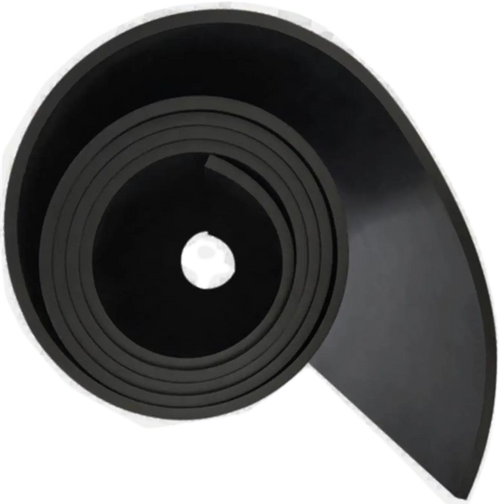
- Can be paired with a beveled transition strip for cleaner exposed edges
Will French Fitness rubber flooring have an odor when first opened?
New rubber products may have a noticeable odor when first removed from their packaging. Remove the product from its packaging and allow it to air out in a well-ventilated area. The odor typically lessens over time, but its intensity and how long it takes to dissipate can vary by product and room conditions, including ventilation, temperature, and room size.
How the Interlocking Edges Work
These tiles have outer tabs intended to connect with tiles having the same interlocking profile. For perimeter pieces, cut the tabs from the side facing the wall or finished outer edge. Verify profile compatibility before connecting tiles from different orders or production versions.
How to Cut the Perimeter So the Edge Looks Straight
- Dry-fit the tile first. Set the tile in place and confirm which side will face the wall, doorway, rack, or post.
- Measure the gap in a few spots. Walls are not always perfectly straight, so measure more than once before marking the cut line.
- Mark a clean line. Use a straight edge or square so the finished cut stays clean and consistent.
- Score in several shallow passes. A fresh utility blade and multiple light passes usually produce a cleaner cut than trying to force one deep pass.
- Support the cut line. If needed, slide scrap wood, plywood, cardboard, or a 2x4 under the cut area so the cut can open as you work.
- Test fit before finishing the whole room. Put the tile back in place, check the wall line, then trim only if needed.
- Finish the exposed edge. If the outer edge is open to regular flooring, add the beveled transition strip for a smoother step-down and a more finished look.
Shop the beveled edge transition strip | Shop French Fitness rubber flooring
Helpful Links
French Fitness Rubber Flooring | Beveled Edge Transition Strip | Financing Options | Warranty | Contact Us | Visit Our Warehouse
Features
- Color: Black
- Thickness: 10 mm
- Dimensions: 39.37" x 39.37" per tile (1 meter squared)
- Weight: 22 lbs per tile
- Warranty: 1-Year Limited
- Shipping: Ships new in boxes. Assembly options available.
Warranty
- 1-Year Limited
HOME PRODUCTS WARRANTY
Effective Date: January 4, 2021
This Warranty applies only to Products manufactured or distributed by French Fitness Inc. under the FRENCH FITNESS brand name.
1.1. This warranty for Home Products covers only those Products specifically designated with the FRENCH FITNESS HOME Warranty badge. These
machines should be used in a home, household or residential setting only for personal use by the original purchaser and extended family.
1.2. We
warrant that the FRENCH FITNESS HOME Products You have purchased is free from defects in materials or workmanship under normal use during the warranty period. This excludes paint and finish.
1.3.
The designation of Products covered by this warranty will be determined at Our sole discretion and stipulated at the owner’s manual.
1.4. During the warranty
period, We will at no additional charge, repair or replace (at Our option) the Product if it becomes defective, malfunctions, or otherwise fails to conform with this Warranty under normal HOME use.
2. VOID WARRANTY
2.1. The warranty for FRENCH FITNESS HOME Products will become void if the machine is used outside a home, household, residential or personal setting.
2.2.
In other words, the warranty will become void if the machine is used in a:
2.2.1. Light commercial setting. A
light commercial facility is one (a) that does NOT charge monthly membership dues and (b) where the equipment would NOT be used by more than 50 people a day; such as in corporate facilities, offices, free-standing retail
establishments, restaurants, churches, small medical facilities, banks, hotels, apartments, condominiums, personal training studios, police and fire stations, and all other light commercial facilities that meet the
limitations listed above.
2.2.2. Commercial setting. A commercial facility is one (a) that charges monthly membership dues or (b) where the equipment
would be used by more than 50 people a day; such as in gyms, health clubs, fitness centers, professional athletics teams, prisons, military bases, government agencies, schools and colleges, hospitals, medical facilities,
rehabilitation centers, park and recreation departments, and all other commercial facilities that exceed the limitations listed above.
3. USA & CANADA
3.1. For Products within USA and Canada, the warranty covers ALL parts for a period 10 Years
from the date of purchase.
3.2. The warranty also covers labor for a period 1 Year from the date
of purchase.
4. INTERNATIONAL WARRANTY
4.1. Outside USA and Canada, the warranty covers ALL parts for a period 3 Years from the date of purchase.
4.2.
The warranty does NOT cover labor.
4.3. We do, however, have technicians available by phone and email who can walk You through installing or diagnosing the issue,
and appropriate part to replace.
5. PARTS
5.1. We will cover all shipping charges related to shipping warrantied parts. Please also note that new Products will include the manufacturer’s warranty, which may
or may not be valid for items shipped outside the USA and Canada.
5.2. If We send parts under the Warranty to You, You agree to return any unused / defective
/ old parts using a return shipping label that We will provide.
5.3. Failure to return any unused / defective / old parts with the
will void the warranty.
5.4. In repairing the Product, We may replace defective parts or, at Our option, serviceable used parts that are equivalent to
new parts in performance. All exchanged parts and Products replaced under this warranty will become Our property. We reserve the right to change manufacturers of any part to cover any existing warranty.
6. SERVICE
6.1. A technician will be dispatched within 1-2 weeks of notification of the service request.
6.2. Warranty
service in Northern California will be performed by Our in house technicians.
6.3. Warranty service outside Northern California will be performed by a trusted
member of Our nationwide network of technicians.
6.4. The warranty will be void if the customer fails to show for a scheduled service call
with a technician, unless the customer pays the technician directly. There will be a trip charge as soon as the technician is dispatched. If the customer fails to show for a scheduled service and does not communicate
with the technician, the customer will be responsible for the trip charge.
7. INCLUSIONS
The Warranty covers the following:
7.1. Any mechanical or electronic issues whatsoever, which are causing the machine to not work like new.
7.2.
Within USA and Canada, 100% labor costs and unlimited on-site technician diagnostic and repair visits.
7.3. 100% parts replacement including structural moving
parts such as bearings, pulleys, cables, motors, and batteries, etc. (if causing the machine to not function).
7.4. Wearable parts such as heart rate monitors,
pedals, treadmill decks, running belts, and track wheels, etc. (if causing the machine to not function).
7.5. Software issues including error screen messages,
program malfunctions, and console resets.
8. EXCLUSIONS
8.1. Any mechanical, software and cosmetic issue that is a direct result of improper use, physical damage, or the user engaging in an activity which the operational manual specifically warns against doing or caused by the user disassembling/reassembling the machine.8.2. Cosmetic defects including but not limited to scratches, broken plastic, peeling stickers/logos/overlays, discoloration, etc., unless the Product has such defect upon receipt of the machine.
8.2.1. If there are any cosmetic defects on arrival, please contact Us within a week of delivery so We can fix the issue. If We are not notified within a week, it will not be covered.
8.3. Water, fire, heat, wind, or elemental damages, such as when the machine being left in an outdoor setting. Leaving the machine outdoors causes the machine to wear and deteriorate significantly quicker than indoors. Garage settings may be covered by the warranty.
8.4. Total Loss. If the Product or major parts of the machine are reported as stolen, missing or lost, the warranty will be void.
8.5. This Warranty does not extend to any Product not purchased from the French Fitness website or from an authorized French Fitness reseller.
8.6. This Warranty does not extend to any Product that has been damaged or rendered defective; (a) as a result of accident, misuse, or abuse; (b) by the use of parts not manufactured or sold by Us; (c) by modification of the Product; (d) as a result of service by anyone other than Us or Our authorized warranty service provider; (e) as a result of failure to provide reasonable and necessary care as outlined in the owner's manual for the Product. Customer is also responsible for reasonable and necessary maintenance. Reasonable and necessary maintenance includes proper cleaning and lubrication as specified in the owner's manual.
8.7. This warranty will not be extended to any product whose serial number has been removed, altered, or defaced.
8.8. This warranty does not cover service calls made to instruct owners on how to operate this equipment.
8.9. This warranty does not cover customer instruction, installation, set-up, or adjustments.
8.10. Should any Product submitted for Warranty service be found to be ineligible, an estimate of repair cost will be furnished and the repair will be made if requested by the customer upon Our receipt of payment or acceptable arrangement of payment.
9. IMPORTANT ADDITIONAL TERMS AND RESTRICTIONS
9.1. Your sales receipt, showing the date of purchase of the Product, is Your proof of the date of purchase. You must present the proof-of-purchase documents
(including the date of purchase). Any evidence of alteration, erasing or forgery of proof-of-purchase documents will be cause to void this warranty.
9.2.
The warranty period starts the moment the Product is in Your possession or delivered to You.
9.3. The warranty extends only to the original purchaser.
It is not transferable to anyone who subsequently purchases the Product.
9.4. This warranty becomes VALID ONLY if the Product is assembled and installed according
to the instructions and directions included with the Product.
10. HOW TO REDEEM WARRANTY
10.1. To redeem this warranty, You must Contact Us.
10.2. We may elect to send a new part to
remedy the defect.
10.3. However in some cases, We may need to directly repair or entirely replace the equipment. You then must return the Product in its original container (or
equivalent) to the address that We will provide. You must pre-pay any shipping charges, export taxes, customs duties and taxes, insurance, and any other charges associated with transportation of the Product. You are
responsible for insuring any Product shipped or returned. You assume the risk of loss during shipment or return.
10.4. We will not accept any Product returned on a freight collect
basis or outside of Our normal business hours.
11. DISCLAIMER
11.1. EXCEPT AS EXPRESSLY SET FORTH IN THIS WARRANTY, WE MAKE NO OTHER WARRANTIES, EXPRESSED OR IMPLIED INCLUDING ANY IMPLIED WARRANTIES OF MERCHANTABILITY AND FITNESS FOR A PARTICULAR
PURPOSE. WE EXPRESSLY DISCLAIM ALL WARRANTIES NOT STATED IN THIS WARRANTY. ANY IMPLIED WARRANTIES THAT MAY BE IMPOSED BY LAW ARE LIMITED TO THE TERMS OF THIS WARRANTY. NEITHER WE NOR ANY OF OUR AFFILIATES SHALL BE RESPONSIBLE
FOR INCIDENTAL OR CONSEQUENTIAL DAMAGES. SOME STATES DO NOT ALLOW LIMITATIONS ON HOW LONG AN IMPLIED WARRANTY LASTS OR THE EXCLUSION OR LIMITATION OF INCIDENTAL OR CONSEQUENTIAL DAMAGES, SO THE ABOVE LIMITATIONS OR
EXCLUSION MAY NOT APPLY TO YOU.
11.2. This warranty gives You specific legal rights and You may also have other rights that may vary from state to state. This is the only express
warranty applicable to French Fitness branded products. We neither assume nor authorize anyone to assume for it any other express warranty.
LIGHT COMMERCIAL PRODUCTS WARRANTY
Effective Date: January 4, 2021
This Warranty applies only to Products manufactured or distributed by French Fitness Inc. under the FRENCH FITNESS brand name.
1.1. This warranty for Light Commercial Products covers only those Products specifically designated with the FRENCH FITNESS LIGHT COMMERCIAL Warranty
badge. These machines should be used in a light commercial setting.
1.2. A light commercial facility is one (a) that does NOT charge monthly membership
dues and (b) where the equipment would NOT be used by more than 50 people a day; such as in corporate facilities, offices, free-standing retail establishments, restaurants, churches, small medical facilities, banks,
hotels, apartments, condominiums, personal training studios, police and fire stations, and all other light commercial facilities that meet the limitations listed above.
1.3.
We warrant that the FRENCH FITNESS LIGHT COMMERCIAL Products You have purchased is free from defects in materials or workmanship under normal use during the warranty
period. This excludes paint and finish.
1.4. The designation of Products covered by this warranty will be determined at Our sole discretion and stipulated at the owner’s manual.
1.5.
During the warranty period, We will at no additional charge, repair or replace (at Our option) the Product if it becomes defective, malfunctions, or otherwise fails to conform with this Warranty under normal LIGHT COMMERCIAL
use.
2. VOID WARRANTY
2.1. The warranty for FRENCH FITNESS LIGHT COMMERCIAL Products will become void if the machine is used outside a light commercial setting.
2.2.
In other words, the warranty will become void if the machine is used in a Commercial setting. A commercial facility is one (a) that charges monthly membership dues or (b) where the equipment would
be used by more than 50 people a day; such as in gyms, health clubs, fitness centers, professional athletics teams, prisons, military bases, government agencies, schools and colleges, hospitals, medical facilities,
rehabilitation centers, park and recreation departments, and all other commercial facilities that exceed the limitations listed above.
3. USA & CANADA
3.1. For Products within USA and Canada, the warranty covers ALL parts for a period 10 Years
from the date of purchase.
3.2. The warranty also covers labor for a period 1 Year from the date
of purchase.
4. INTERNATIONAL WARRANTY
4.1. Outside USA and Canada, the warranty covers ALL parts for a period 3 Years from the date of purchase.
4.2.
The warranty does NOT cover labor.
4.3. We do, however, have technicians available by phone and email who can walk You through installing or diagnosing the issue,
and appropriate part to replace.
5. Parts
5.1. We will cover all shipping charges related to shipping warrantied parts.
Please also note that new Products will include the manufacturer’s warranty, which may or may not be valid for items shipped outside the USA and Canada.
5.2.
If We send parts under the Warranty to You, You agree to return any unused / defective / old parts using a return shipping label that We will provide.
5.3. Failure
to return any unused / defective / old parts with the will void the warranty.
5.4. In repairing the Product, We may replace
defective parts or, at Our option, serviceable used parts that are equivalent to new parts in performance. All exchanged parts and Products replaced under this warranty will become Our property. We reserve the right
to change manufacturers of any part to cover any existing warranty.
6. SERVICE
6.1. A technician will be dispatched within 1-2 weeks of notification of the service request.
6.2. Warranty
service in Northern California will be performed by Our in house technicians.
6.3. Warranty service outside Northern California will be performed by a trusted
member of Our nationwide network of technicians.
6.4. The warranty will be void if the customer fails to show for a scheduled service call
with a technician, unless the customer pays the technician directly. There will be a trip charge as soon as the technician is dispatched. If the customer fails to show for a scheduled service and does not communicate
with the technician, the customer will be responsible for the trip charge.
7. INCLUSIONS
The Warranty covers the following:
7.2. Within USA and Canada, 100% labor costs and unlimited on-site technician diagnostic and repair visits.
7.3. 100% parts replacement including structural moving parts such as bearings, pulleys, cables, motors, and batteries, etc. (if causing the machine to not function).
7.4. Wearable parts such as heart rate monitors, pedals, treadmill decks, running belts, and track wheels, etc. (if causing the machine to not function).
7.5. Software issues including error screen messages, program malfunctions, and console resets.
8. EXCLUSIONS
8.1. Any mechanical, software and cosmetic issue that is a direct result of improper use, physical damage, or the user engaging in an activity which the operational manual specifically warns against doing or caused by the user disassembling/reassembling the machine.8.2. Cosmetic defects including but not limited to scratches, broken plastic, peeling stickers/logos/overlays, discoloration, etc., unless the Product has such defect upon receipt of the machine.
8.2.1. If there are any cosmetic defects on arrival, please contact Us within a week of delivery so We can fix the issue. If We are not notified within a week, it will not be covered.
8.3. Water, fire, heat, wind, or elemental damages, such as when the machine being left in an outdoor setting. Leaving the machine outdoors causes the machine to wear and deteriorate significantly quicker than indoors. Garage settings may be covered by the warranty.
8.4. Total Loss. If the Product or major parts of the machine are reported as stolen, missing or lost, the warranty will be void.
8.5. This Warranty does not extend to any Product not purchased from the French Fitness website or from an authorized French Fitness reseller.
8.6. This Warranty does not extend to any Product that has been damaged or rendered defective; (a) as a result of accident, misuse, or abuse; (b) by the use of parts not manufactured or sold by Us; (c) by modification of the Product; (d) as a result of service by anyone other than Us or Our authorized warranty service provider; (e) as a result of failure to provide reasonable and necessary care as outlined in the owner's manual for the Product. Customer is also responsible for reasonable and necessary maintenance. Reasonable and necessary maintenance includes proper cleaning and lubrication as specified in the owner's manual.
8.7. This warranty will not be extended to any product whose serial number has been removed, altered, or defaced.
8.8. This warranty does not cover service calls made to instruct owners on how to operate this equipment.
8.9. This warranty does not cover customer instruction, installation, set-up, or adjustments.
8.10. Should any Product submitted for Warranty service be found to be ineligible, an estimate of repair cost will be furnished and the repair will be made if requested by the customer upon Our receipt of payment or acceptable arrangement of payment.
9. IMPORTANT ADDITIONAL TERMS AND RESTRICTIONS
9.1. Your sales receipt, showing the date of purchase of the Product, is Your proof of the date of purchase. You must present the proof-of-purchase documents
(including the date of purchase). Any evidence of alteration, erasing or forgery of proof-of-purchase documents will be cause to void this warranty.
9.2.
The warranty period starts the moment the Product is in Your possession or delivered to You.
9.3. The warranty extends only to the original purchaser.
It is not transferable to anyone who subsequently purchases the Product.
9.4. This warranty becomes VALID ONLY if the Product is assembled and installed according
to the instructions and directions included with the Product.
10. HOW TO REDEEM WARRANTY
10.1. To redeem this warranty, You must Contact Us.
10.2. We may elect to send a new part to
remedy the defect.
10.3. However in some cases, We may need to directly repair or entirely replace the equipment. You then must return the Product in its original container (or
equivalent) to the address that We will provide. You must pre-pay any shipping charges, export taxes, customs duties and taxes, insurance, and any other charges associated with transportation of the Product. You are
responsible for insuring any Product shipped or returned. You assume the risk of loss during shipment or return.
10.4. We will not accept any Product returned on a freight collect
basis or outside of Our normal business hours.
11. DISCLAIMER
11.1. EXCEPT AS EXPRESSLY SET FORTH IN THIS WARRANTY, WE MAKE NO OTHER WARRANTIES, EXPRESSED OR IMPLIED INCLUDING ANY IMPLIED WARRANTIES OF MERCHANTABILITY AND FITNESS FOR A PARTICULAR
PURPOSE. WE EXPRESSLY DISCLAIM ALL WARRANTIES NOT STATED IN THIS WARRANTY. ANY IMPLIED WARRANTIES THAT MAY BE IMPOSED BY LAW ARE LIMITED TO THE TERMS OF THIS WARRANTY. NEITHER WE NOR ANY OF OUR AFFILIATES SHALL BE RESPONSIBLE
FOR INCIDENTAL OR CONSEQUENTIAL DAMAGES. SOME STATES DO NOT ALLOW LIMITATIONS ON HOW LONG AN IMPLIED WARRANTY LASTS OR THE EXCLUSION OR LIMITATION OF INCIDENTAL OR CONSEQUENTIAL DAMAGES, SO THE ABOVE LIMITATIONS OR
EXCLUSION MAY NOT APPLY TO YOU.
11.2. This warranty gives You specific legal rights and You may also have other rights that may vary from state to state. This is the only express
warranty applicable to French Fitness branded products. We neither assume nor authorize anyone to assume for it any other express warranty.
COMMERCIAL PRODUCTS WARRANTY
Effective Date: January 4, 2021
This Warranty applies only to Products manufactured or distributed by French Fitness Inc. under the FRENCH FITNESS brand name.
1.1. This warranty for COMMERCIAL Products covers only those Products specifically designated with the FRENCH FITNESS COMMERCIAL Warranty
badge. These machines should be used in a commercial setting.
1.2. A commercial facility is one (a) that charges monthly membership dues or (b) where
the equipment is used by more than 50 people a day; such as in gyms, health clubs, fitness centers, professional athletics teams, prisons, military bases, government agencies, schools and colleges, hospitals, medical
facilities, rehabilitation centers, park and recreation departments, and all other commercial facilities that exceed the limitations listed above.
1.3. We
warrant that the FRENCH FITNESS COMMERCIAL Products You have purchased is free from defects in materials or workmanship under normal use during the warranty
period. This excludes paint and finish.
1.4. The designation of Products covered by this warranty will be determined at Our sole discretion and stipulated at the owner’s manual.
1.5.
During the warranty period, We will at no additional charge, repair or replace (at Our option) the Product if it becomes defective, malfunctions, or otherwise fails to conform with this Warranty under normal COMMERCIAL
use.
2.1. For Products within USA and Canada, the warranty covers ALL parts for a period 10 Years
from the date of purchase.
2.2. The warranty also covers labor for a period 1 Year from the date of purchase.
3. INTERNATIONAL WARRANTY
3.1. Outside USA and Canada, the warranty covers ALL parts for a period 3 Years from the date of purchase.3.2. The warranty does NOT cover labor.
3.3. We do, however, have technicians available by phone and email who can walk You through installing or diagnosing the issue, and appropriate part to replace.
4. PARTS
4.1. We will cover all shipping charges related to shipping warrantied parts. Please also note that new Products will include the manufacturer’s warranty, which
may or may not be valid for items shipped outside the USA and Canada.
4.2. If We send parts under the Warranty to You, You agree to return any unused / defective
/ old parts using a return shipping label that We will provide.
4.3. Failure to return any unused / defective / old parts with
the will void the warranty.
4.4. In repairing the Product, We may replace defective parts or, at Our option, serviceable used parts that are equivalent
to new parts in performance. All exchanged parts and Products replaced under this warranty will become Our property. We reserve the right to change manufacturers of any part to cover any existing warranty.
5. SERVICE
5.1. A technician will be dispatched within 1-2 weeks of notification of the service request.
5.2. Warranty
service in Northern California will be performed by Our in house technicians.
5.3. Warranty service outside Northern California will be performed by a trusted
member of Our nationwide network of technicians.
5.4. The warranty will be void if the customer fails to show for a scheduled service call
with a technician, unless the customer pays the technician directly. There will be a trip charge as soon as the technician is dispatched. If the customer fails to show for a scheduled service and does not communicate
with the technician, the customer will be responsible for the trip charge.
6. INCLUSIONS
The Warranty covers the following:
6.1. Any mechanical or electronic issues whatsoever, which are causing the machine to not work like new.
6.2.
Within USA and Canada, 100% labor costs and unlimited on-site technician diagnostic and repair visits.
6.3. 100% parts replacement including structural moving
parts such as bearings, pulleys, cables, motors, and batteries, etc. (if causing the machine to not function).
6.4. Wearable parts such as heart rate monitors,
pedals, treadmill decks, running belts, and track wheels, etc. (if causing the machine to not function).
6.5. Software issues including error screen messages,
program malfunctions, and console resets.
7. EXCLUSIONS
7.1. Any mechanical, software and cosmetic issue that is a direct result of improper use, physical damage, or the user engaging in an activity which the operational manual specifically warns against doing or caused by the user disassembling/reassembling the machine.7.2. Cosmetic defects including but not limited to scratches, broken plastic, peeling stickers/logos/overlays, discoloration, etc., unless the Product has such defect upon receipt of the machine.
7.2.1. If there are any cosmetic defects on arrival, please contact Us within a week of delivery so We can fix the issue. If We are not notified within a week, it will not be covered.
7.3. Water, fire, heat, wind, or elemental damages, such as when the machine being left in an outdoor setting. Leaving the machine outdoors causes the machine to wear and deteriorate significantly quicker than indoors. Garage settings may be covered by the warranty.
7.4. Total Loss. If the Product or major parts of the machine are reported as stolen, missing or lost, the warranty will be void.
7.5. This Warranty does not extend to any Product not purchased from the French Fitness website or from an authorized French Fitness reseller.
7.6. This Warranty does not extend to any Product that has been damaged or rendered defective; (a) as a result of accident, misuse, or abuse; (b) by the use of parts not manufactured or sold by Us; (c) by modification of the Product; (d) as a result of service by anyone other than Us or Our authorized warranty service provider; (e) as a result of failure to provide reasonable and necessary care as outlined in the owner's manual for the Product. Customer is also responsible for reasonable and necessary maintenance. Reasonable and necessary maintenance includes proper cleaning and lubrication as specified in the owner's manual.
7.7. This warranty will not be extended to any product whose serial number has been removed, altered, or defaced.
7.8. This warranty does not cover service calls made to instruct owners on how to operate this equipment.
7.9. This warranty does not cover customer instruction, installation, set-up, or adjustments.
7.10. Should any Product submitted for Warranty service be found to be ineligible, an estimate of repair cost will be furnished and the repair will be made if requested by the customer upon Our receipt of payment or acceptable arrangement of payment.
8. IMPORTANT ADDITIONAL TERMS AND RESTRICTIONS
8.1. Your sales receipt, showing the date of purchase of the Product, is Your proof of the date of purchase. You must present the proof-of-purchase documents
(including the date of purchase). Any evidence of alteration, erasing or forgery of proof-of-purchase documents will be cause to void this warranty.
8.2.
The warranty period starts the moment the Product is in Your possession or delivered to You.
8.3. The warranty extends only to the original purchaser.
It is not transferable to anyone who subsequently purchases the Product.
8.4. This warranty becomes VALID ONLY if the Product is assembled and installed according
to the instructions and directions included with the Product.
9. HOW TO REDEEM WARRANTY
9.1. To redeem this warranty, You must Contact Us.
9.2.
We may elect to send a new part to remedy the defect.
9.3. However in some cases, We may need to directly repair or entirely replace the equipment. You then
must return the Product in its original container (or equivalent) to the address that We will provide. You must pre-pay any shipping charges, export taxes, customs duties and taxes, insurance, and any other charges
associated with transportation of the Product. You are responsible for insuring any Product shipped or returned. You assume the risk of loss during shipment or return.
9.4.
We will not accept any Product returned on a freight collect basis or outside of Our normal business hours.
10. DISCLAIMER
10.1. EXCEPT AS EXPRESSLY SET FORTH IN THIS WARRANTY, WE MAKE NO OTHER WARRANTIES, EXPRESSED OR IMPLIED INCLUDING ANY IMPLIED WARRANTIES OF MERCHANTABILITY AND FITNESS FOR A PARTICULAR
PURPOSE. WE EXPRESSLY DISCLAIM ALL WARRANTIES NOT STATED IN THIS WARRANTY. ANY IMPLIED WARRANTIES THAT MAY BE IMPOSED BY LAW ARE LIMITED TO THE TERMS OF THIS WARRANTY. NEITHER WE NOR ANY OF OUR AFFILIATES SHALL
BE RESPONSIBLE FOR INCIDENTAL OR CONSEQUENTIAL DAMAGES. SOME STATES DO NOT ALLOW LIMITATIONS ON HOW LONG AN IMPLIED WARRANTY LASTS OR THE EXCLUSION OR LIMITATION OF INCIDENTAL OR CONSEQUENTIAL DAMAGES, SO THE ABOVE
LIMITATIONS OR EXCLUSION MAY NOT APPLY TO YOU.
10.2. This warranty gives You specific legal rights and You may also have other rights that may vary from state to state. This
is the only express warranty applicable to French Fitness branded products. We neither assume nor authorize anyone to assume for it any other express warranty.